US-RSE May 2026 Newsletter
🙌 There Are Dozens of Us, DOZENS! 🙌
Published: May 20, 2026 by Tinashe M. Tapera (Author & Editor), Sandra Gesing (Editor), Ian Cosden (Editor)
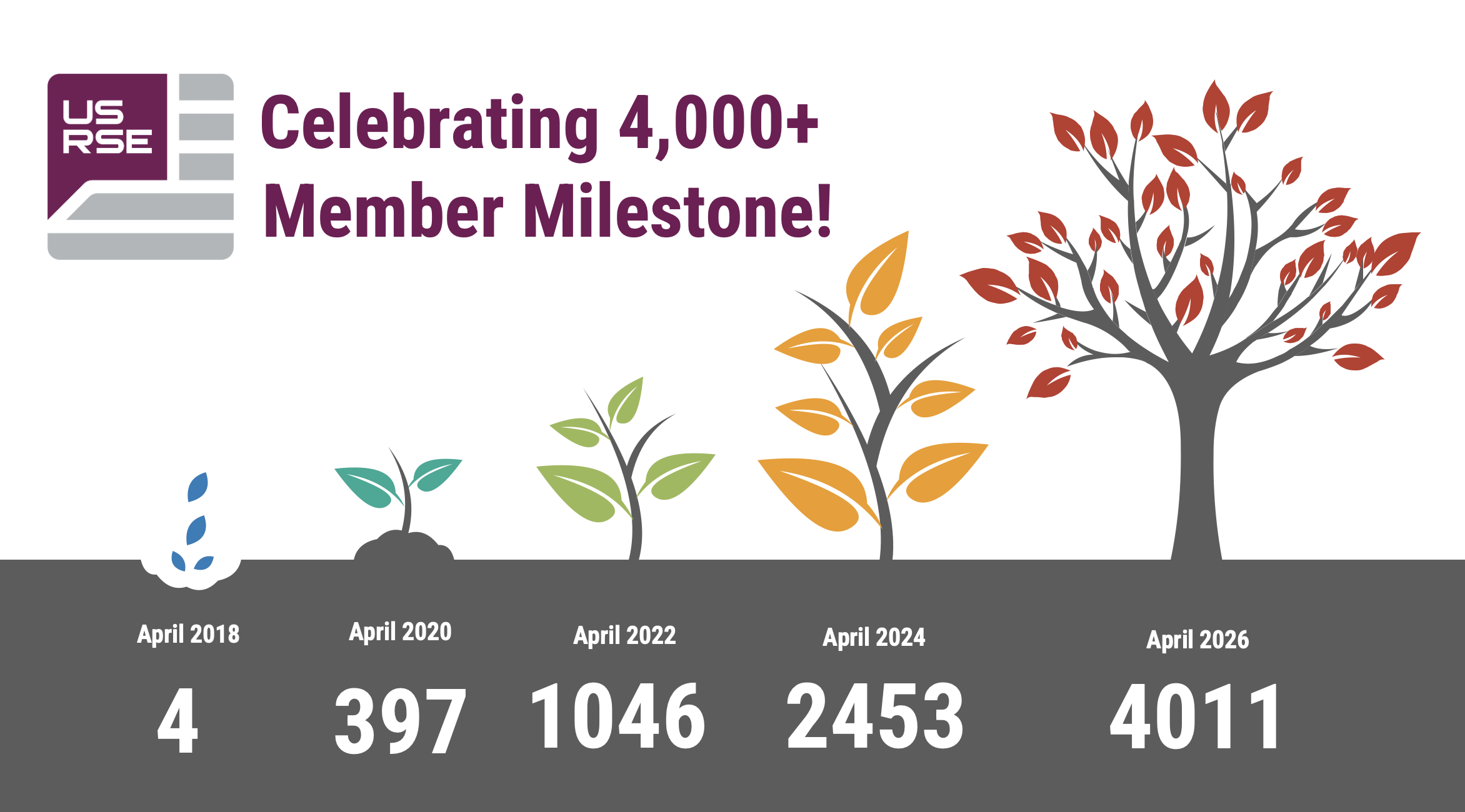
Well, actually, there are thousands — four thousand and counting, to be exact! That’s right, as of April 2026, US-RSE has grown to over 4,000 registered members! That means if you tried to count every member one by one, it would take you over an hour to count them all. 4000 is also a Harshad number, which means it’s divisible by the sum of its digits (4 + 0 + 0 + 0 = 4). So, in a way, our membership is mathematically harmonious! Also, did you know that the recent Artemis mission flew approximately 4000 miles above the moon’s surface? Okay, you get the point — that’s a lot of RSEs, and we’re thrilled to have each and every one of you as part of our community.
So grab a beverage, sit back, and dive in to the latest news and updates from your 4000-member-strong community of research software engineers!
In this issue:
- 1 🤩 Wait a Minute, I’m an RSE, I Know How to Do That! 🤩
- 2 📣 Mark Your Calendars for USRSE’26! 📣
- 3 🤝 Organizational Founding Membership 🤝
- 4 🗞️ Community News 🗞️
- 5 👀 Interesting Events and Opportunities 👀
- 6 📚 Featured Reads, Videos, and Podcasts 📚
- 7 🏃 Get Involved! 🏃
- 8 🧑💼 Recent Job Postings 🧑💼
🤩 Wait a Minute, I’m an RSE, I Know How to Do That! 🤩
I know how to do that!
It is one of the most rewarding thoughts you can have as a research software engineer: that moment when you notice a colleague, PI, collaborator, or student struggling with a software problem and realize you can help.
Not because they are unmotivated. Not because they are bad scientists. But because things are not working, not moving quickly enough, or not being recognized for what they are: software problems that can be solved with the right tools, techniques, and expertise. Maybe the scientist is looking toward industry and thinking, “I wish we could move as quickly as Google, Facebook, or Microsoft.” Or, more recently, “I wish we could figure out how to really use all this LLM stuff.” Ever persistent, the scientist keeps chasing their research questions. They want to discover the next big thing in their field. They want to make an impact. But because their workflow was essentially written in 2012, and because they do not have the time, support, or expertise to modernize it, they are stuck moving at the pace of 2012.
And as RSEs, we get it! Code can be fragile — and scary. If a new student or postdoc touches it, they might break it. If the code breaks, so might every paper, grant, and project built on top of it. When was the last time it was updated? Months ago? Years ago? So the scientist does not touch it. They treat it like a Rube Goldberg machine: they know it works, but they no longer remember how. At this point, they are too afraid to find out.
As RSEs, we see this…and get excited.
Because we know how to help. 🥹
I first came across the term “RSE” in the wonderfully cute and informative 2019 YouTube video, The Story of the Research Engineer, and I instantly fell in love with the idea. Here was a name for the squeaky wheel that gets the grease: the person who helps scientists get unstuck, move faster, and work more sustainably. But then as now, the field was young. There was not much consensus about what an RSE was, where they belonged, or how institutions should support them.
The term itself emerged in the UK in 2012, after a group of researchers and software practitioners began formalizing a role that many people were already doing but few institutions knew how to recognize. Since then, definitions have been proposed, refined, and debated.
Ian Cosden, Chair of the US-RSE Steering Committee and Senior Director of Research Software Engineering at Princeton, defines the role partly by what it is not. An RSE, he argues, is not simply a researcher, not simply a facilitator, and not simply a pure software engineer. The role lives in the productive space between those identities.
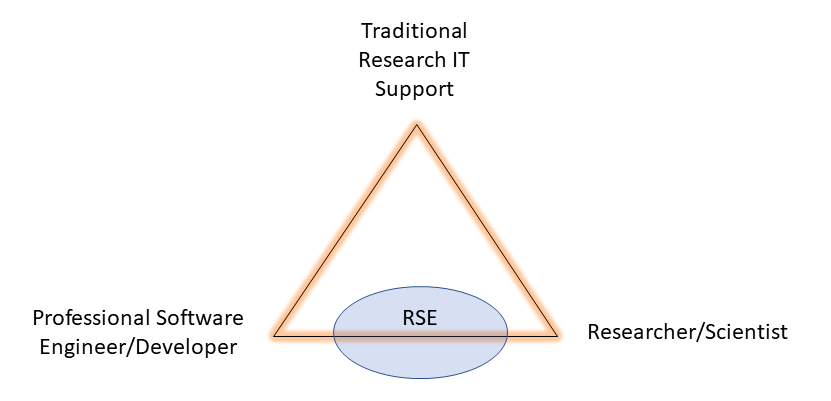
Goth et al. (2025) offer one recent attempt to concretize the foundational competencies and responsibilities of an RSE, including software development, building and distributing software assets, understanding the research lifecycle, and supporting reproducible, sustainable research. Vanessa Sochat’s EasyBuild talk, on the other hand, emphasizes just how broad this space can be: among roughly 400 people surveyed who identified themselves to be working on “research software” in some capacity, there were more than 190 unique job titles. That degree of diversity can be both a strength and a challenge. It shows how widely research software work appears across institutions, but it also explains why the role can be so difficult to define, hire for, promote, and reward. Another one of our US-RSE members, Dan Katz, proposes a 3-dimensional schematic to isolate the Super RSE role who commands “a superset of the responsibilities of the traditional RSE role, combining both service and the RSE’s own research.”

By identifying this RSE unicorn, Katz highlights the fact that as we define the breadth of the scope of the RSE, we also need to think about its potentially necessary boundaries.
In a 2022 career Q&A in Nature, Paul Richmond predicted that RSEs could become equals in the academic environment if they receive proper recognition for their contributions. James Schloss, in his YouTube talk highlights some of the barriers still standing in the way: the publication economy, academic resistance to software engineering best practices, and the difficulty of competing with industry salaries for people with similar technical expertise. In fact, one of my very first suggestions for newsletter topics was to discuss the definition of the title “Research Software Engineer” itself, and I was told very firmly to avoid the topic as much as possible — not because it was inflammatory, but because it remains a particularly sensitive topic. While many are strongly attached to the name for its truthiness, just as many others are more concerned with defining the tasks, responsibilities, and competencies of the role, regardless of what it is called, because funding sources will pay a great deal of attention to those details.
But friends, there is hope. 🌱
Just as a small group of concerned scientists and software practitioners began with an idea, a conversation, and a Google Group, we can continue making the role visible at our own institutions. This can be through formal titles, clearer career paths, better credit, stronger communities of practice, or simply naming the work when we see it as we help research software engineering become easier to recognize and harder to ignore. This week, celebrate yourself by encouraging your colleagues, coworkers, PIs, and students to make this role visible. Look around. We are once again watching technology change the fabric of research itself. Rigorous science, and the software that powers it, cannot afford to be left behind. Now more than ever, research needs talented, driven, curious technology specialists who can ask new questions, solve impossible bugs, push compute clusters to their limits, and preserve the code — and the science — that so many people depend on.
Our Executive Director had this to say about the significance of this exceptional milestone:
“Reaching more than 4,000 members is not just a milestone in numbers - it reflects a growing community of people who care deeply about advancing research through software, collaboration, and support for one another. As Executive Director, I am incredibly grateful to be part of this community and inspired every day by the generosity, expertise, and passion our members bring to US-RSE. Thank you for helping build a place where research software engineers can truly belong.” Sandra.
This month, we thank the scrappy and passionate group of researchers who helped crystallize the idea of the Research Software Engineer, one quiet afternoon in Oxford, UK, in 2012. And the next time you notice a colleague struggling with a technical problem, be the RSE on their shoulder. Gently remind them:
Hey, I know how to do that.
You are braver than you believe, stronger than you seem, and smarter than you think. A. A. Milne, Winnie the Pooh
📣 Mark Your Calendars for USRSE’26! 📣
Save the date for USRSE’26: Advancing Science in the Age of AI
We’re thrilled to announce that USRSE’26 will be held at the San Jose Marriott from October 19-21, 2026 in San Jose, California, with the theme “Advancing Science in the Age of AI”.
Chairs have been appointed to lead each of the core committees for USRSE’26. These chairs have begun assembling sub‑teams from the pool of volunteers who expressed interest in supporting the respective areas. If you were not selected for a chair position, please stay tuned, as chairs reach out for volunteers for these committee positions.
What’s next?
- Call for Proposals: Submit your work via papers, short talks, BoFs, workshops, or posters. View More
- Call for Reviewers: Play a key role in creating a dynamic and varied technical program that will appeal to conference attendees from all RSE backgrounds. Apply to Review
- Committee Formation: Sub‑teams will be formed shortly; be on the lookout for an email from a perspective committee chair with details.
- Stay Informed: Regular updates will be posted at us-rse.org/usrse26. Please bookmark the page and check back frequently for the latest information.
Your continued involvement is essential to the success of USRSE’26. We look forward to collaborating with you to deliver a vibrant, inclusive, and impactful conference.
📧 Join Our Mailing List 📧
Want to stay updated on all things US-RSE? Join our mailing list to receive direct news about all US-RSE conferences. Sign up here.
💬 Have Questions? 💬
If you have any questions, feel free to reach out to the organizers at usrse26-conference@us-rse.org.
📅 Save the Date 📅
More details about the conference program, registration, and travel information will be coming your way in the months ahead. Stay tuned at us-rse.org/usrse26!
We’re looking forward to seeing you all in San Jose!
🤝 Organizational Founding Membership 🤝
US-RSE envisions a future where Research Software Engineers are universally respected for advancing science, technology, and society through the transformative power of research software engineering. We’re excited to share that the momentum around our Organizational Founding Membership continues to grow! See the list below for the current members (six more are onboarding at the moment).
Organizations that join on or before June 30, 2026, will be recognized in perpetuity as founding members. Founding organizations will also lock in current membership fees through December 31, 2028. Organizational support helps sustain and expand vital community offerings, including the annual conference, monthly calls and newsletter, job board, working groups, and new resources.
Please reach out to Sandra Gesing at sandra@us-rse.org if you are interested in becoming an organizational founding member!
Premier Members
Standard Members
Basic Members
🗞️ Community News 🗞️
Community Shoutouts
🥳 Congratulations to members of the RSE community recognized with Stanford Data Science (CORES) awards!
- Malcolm Barrett & Alex Koufos : OpenSource@Stanford Community Prize
- Ellianna Abrahams: Open Science Innovator Prize
These awards recognize individuals who have made significant contributions to open science and data science, and we’re thrilled to see members of our community being honored for their impactful work!
Additionally, The RAPTOR team from Argonne National Laboratory and collaborating institutions recently won the SC25 Best Reproducibility Advancement Award, using Chameleon Cloud to make their artifact fully reproducible. This marks the second consecutive year a Chameleon user has taken home this honor!
Read the announcement here.
RSE’s with a New York State of Mind… 🗽
The NYC Regional Group recently met up for their inaugural in-person hangout! Special thanks to Roger Ferger for spearheading the event!
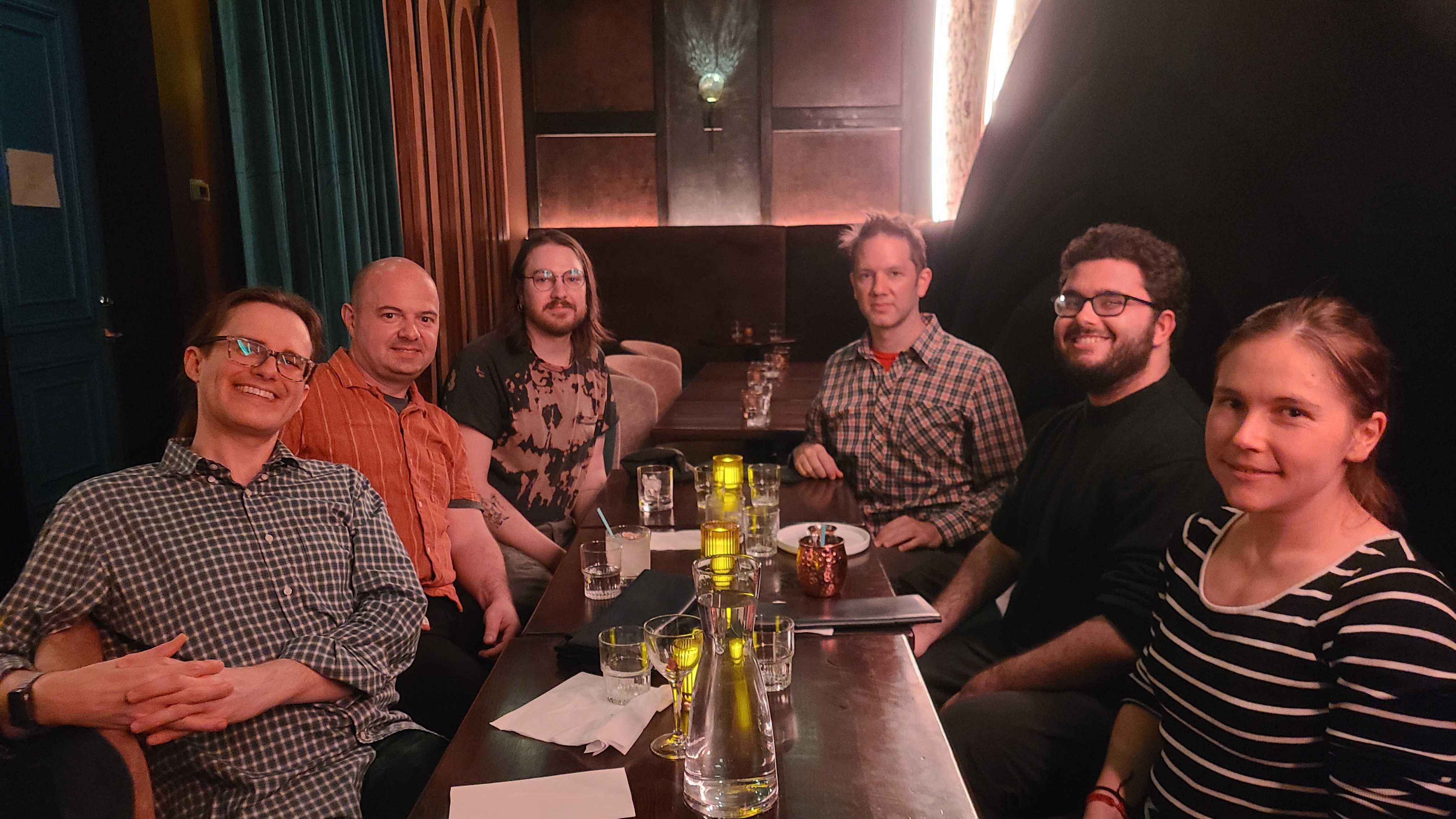
As an added bonus, the group also now has a dedicated page on the US-RSE website! Check it out here to learn more about the group and how to get involved.
Did you know that we have a community Code of Conduct? Anyone is able to view it in the
#code_of_conductSlack channel, underFiles!
Community Calls
Our next meeting is scheduled for Friday, June 12, 2026, 12:00PM EST. We hope to see you there!
👀 Interesting Events and Opportunities 👀
🚀 Supercomputing and the Future of AI: Watch the Full Virtual Exchange Series On-Demand! 🤖
🚀 Contribute to the future of DEI in US-RSE
Have an event or opportunity you want to promote? Reach out on Slack in
the #newsletters channel!
📚 Featured Reads, Videos, and Podcasts 📚
📑 Publications
-
Armstrong, M., Carver, J., Milewicz, R.et al. (2026-10). Characterizing the security culture of the research software engineering community: An empirical study, Future Generation Computer Systems 183. Read the Article.
-
Armstrong, M., Carver, J., Milewicz, R. (2026-10). Preparing research software engineers to become security champions: Development and evaluation of a security awareness workshop, Future Generation Computer Systems 183. Read the Article.
-
Carver, J., Cosden, I., Hill, C.et al. (2021-06). Sustaining Research Software via Research Software Engineers and Professional Associations, 2021 IEEE/ACM International Workshop on Body of Knowledge for Software Sustainability (BoKSS). Read the Article.
-
Cosden, I., Holtz, E., Bretheim, J. (2026-10). Designing and implementing a comprehensive research software engineer career ladder: A case study from Princeton University, Future Generation Computer Systems 183. Read the Article.
-
Crouch, S., Hong, N., Hettrick, S.et al. (2013-11). The Software Sustainability Institute: Changing Research Software Attitudes and Practices, Computing in Science & Engineering 15(6). Read the Article.
-
Hasselbring, W., Katz, D., Nieuwpoort, R. (2026-01). Technology Research Software: An Often Overlooked Category of Research Software, Computing in Science & Engineering 28(1). Read the Article.
-
Kamali, A., Colegrove, A., Voelz, A.et al.. Community Software Facility Discovery Workshop Report: Scientific software best practices, tools, and culture, . Check it out.
-
Martina, T., Saad, M., Rucco, C.et al. (2026-10). Empirical evaluation of LLMs capabilities for data pipeline generation on Databricks platform, Future Generation Computer Systems 183. Read the Article.
-
Mineault, P.. Good Research Code handbook, .
-
Posada, E., Holmen, J., Rentschler, A. (2026-09). Oak Ridge Computing Academy: An HPC cluster deployment and management pilot, Future Generation Computer Systems 182. Read the Article.
🎧 Podcast Episodes
-
** (2026). [EN] ByteSized: Create your web-site with GitHub Pages - J Cohen, S Gibson - Code for Thought, . Listen here🔊.
-
** (2026). [EN] Computing, but not as you know it: Field Programmable Gate Arrays (FPGA) - with Michael McLeod - Code for Thought, . Listen here🔊.
-
** (2026). [EN] Managing Packages with Pixi - Raniere de Silva and Wolf Vollprecht - Code for Thought, . Listen here🔊.
📇 Blog Posts, Videos, & Other Reads
-
Sochat, V., Katz, D., Cosden, I.et al. (2026). A kind-of brief shared early history of US-RSE, . Check it out.
-
Wilson, G.. Managing Research Software Projects, . Check it out.
-
Hettrick, S.. A not-so-brief history of Research Software Engineers | Software Sustainability Institute, . Check it out.
Did you read something interesting this week? Want to share your own
publications in the community? Reach out on Slack in the #newsletters
channel!
🏃 Get Involved! 🏃
US-RSE Working Groups:
- Code Review
- Community Calls
- Diversity, Equity, and Inclusion
- Education and Training
- Group Management
- Mentorship Program
- Outreach
- RSE Empowerment in National Labs
- RSE Group Leaders' Network
- Testing
- User Experience
- Website
🧑💼 Recent Job Postings 🧑💼
-
DevOps Engineer
📍 Flow Science, Inc., Chapel Hill, NC
🗓️ Posted: 2026-10-16 | Expires: 2026-12-31 -
Scientific Developer for UFS In-Core Data Assimilation
📍 Lynker, College Park, MD
🗓️ Posted: 2026-10-15 | Expires: 2026-11-13 -
Software Developer / Scientist - WEAP Platform
📍 Stockholm Environment Institute (SEI), Davis, CA
🗓️ Posted: 2026-10-11 | Expires: 2026-12-01 -
Computer Scientist II
📍 Axiom Consultants, Riverdale Park, MD
🗓️ Posted: 2026-10-09 | Expires: 2026-10-30 -
Lead Airborne Systems - Software Engineer IV
📍 NCAR, Boulder, CO
🗓️ Posted: 2026-10-08 | Expires: 2026-10-23 -
2027 Luis W Alvarez and Grace M Hopper Postdoctoral Fellowships
📍 Lawrence Berkeley National Laboratory, Berkeley, CA
🗓️ Posted: 2026-10-07 | Expires: 2026-10-30 -
Lead, Geospatial Artificial Intelligence and Machine Learning
📍 Yale Center for Geospatial Solutions, New Haven, CT
🗓️ Posted: 2026-10-07 | Expires: 2026-10-30 -
Research Scientist I/II
📍 Georgia Tech, Atlanta, GA
🗓️ Posted: 2026-10-01 | Expires: 2026-12-01 -
Fire Weather and Atmospheric Composition Model Developer
📍 The Cooperative Institute for Research in the Atmosphere (CIRA), Colorado State University (CSU), Boulder, CO
🗓️ Posted: 2026-09-29 | Expires: 2026-10-26 -
Research Software Engineer -- Robotics and Simulation Specialty
📍 JHU Data Science and AI Institute, Baltimore, MD
🗓️ Posted: 2026-09-28 | Expires: 2026-12-31 -
Senior Research Software Engineer
📍 New York University, New York, NY
🗓️ Posted: 2026-09-18 | Expires: 2026-12-01 -
Senior Computational Specialist
📍 New York University, New York, NY
🗓️ Posted: 2026-09-18 | Expires: 2026-12-01 -
Research Engineer (Speech AI/ML)
📍 Renaissance Philanthropy, Engineering Hub, Remote/flexible, offices available in New York, Washington D.C., London, and Tokyo
🗓️ Posted: 2026-08-19 | Expires: 2026-10-31 -
Member of Technical Staff - Product Engineer
📍 Berkeley Institute for Data Science, Berkeley, CA
🗓️ Posted: 2026-08-18 | Expires: 2026-12-01 -
Member of Technical Staff - Research Software Engineer
📍 Berkeley Institute for Data Science, Berkeley, CA
🗓️ Posted: 2026-08-18 | Expires: 2026-12-01 -
Open Source Research Software Engineer - Product
📍 Berkeley Institute for Data Science, Berkeley, CA
🗓️ Posted: 2026-08-18 | Expires: 2026-12-01 -
Open Source Research Software Engineer - Agentic AI
📍 Berkeley Institute for Data Science, Berkeley, CA
🗓️ Posted: 2026-08-18 | Expires: 2026-12-01 -
Open Source Research Software Engineer - User Interfaces
📍 Berkeley Institute for Data Science, Berkeley, CA
🗓️ Posted: 2026-08-18 | Expires: 2026-12-01 -
Senior Software Engineer, Backend Services
📍 University of Chicago - Globus Search & Insights, Chicago, IL (Hybrid)
🗓️ Posted: 2026-08-14 | Expires: 2026-10-31 -
Research Software Engineer
📍 University of Chicago, Data Science Institute, Chicago, IL
🗓️ Posted: 2026-08-07 | Expires: 2027-01-31
Other Job Boards
- Research Software Engineering Opportunities in other associations/societies
- Software Carpentries Job Opportunities
- Academic Data Science Alliance Jobs
- High Performance Computing (HPC) Jobs from hpc.social
- SGX3 and SGCI Science Gateways Community Jobs Board
You can learn more about job boards in the #jobs Slack channel!
This newsletter is a joint effort of members of the US-RSE Association.
© US-RSE • 2021–2026 • US-RSE is a fiscally sponsored project of Community Initiatives